
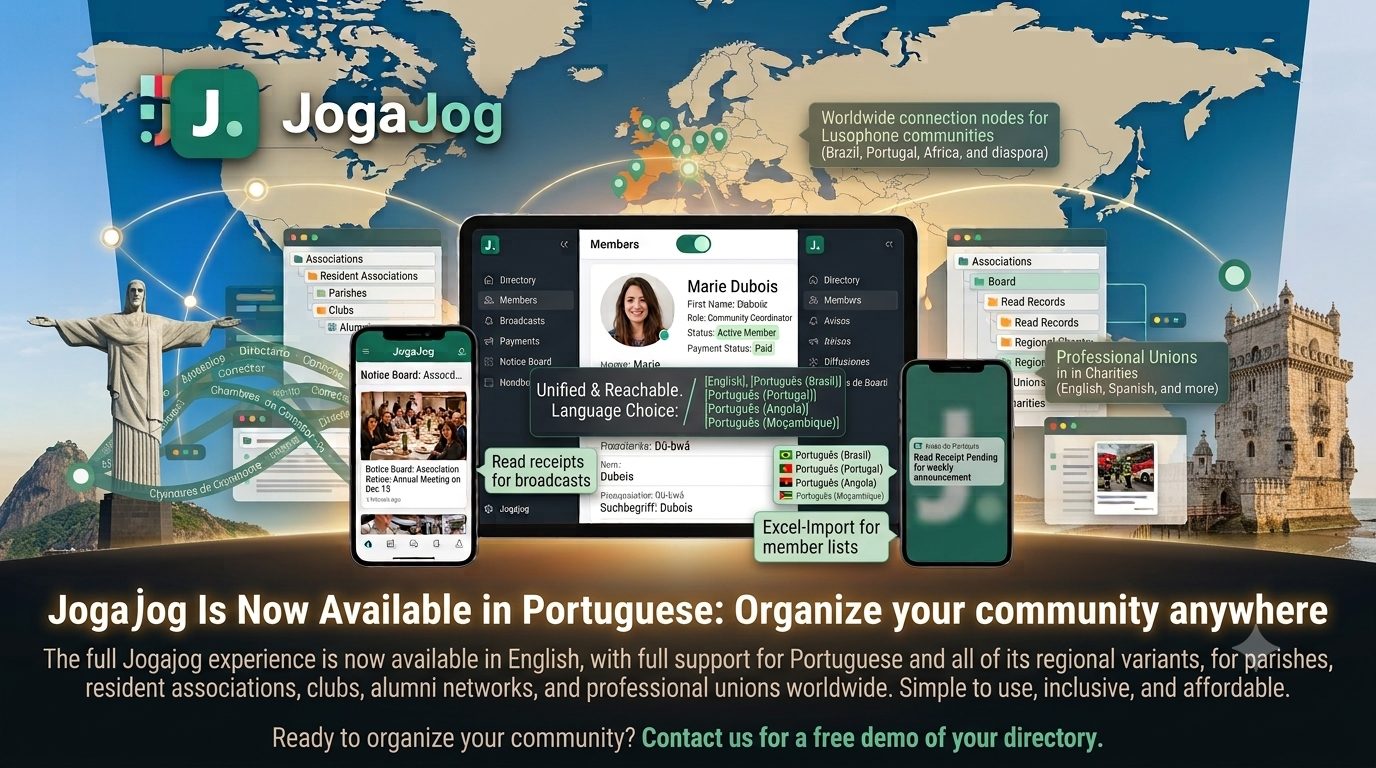
Jogajog now speaks Portuguese
As of today, the complete Jogajog experience is available in Portuguese — not just a few translated menus, but the entire app, from the member directory to broadcasts and notices. Portuguese now joins the 25 languages already supported by the platform, alongside right-to-left languages such as Arabic, Urdu, and Persian, all built to the same standard of quality.
For anyone organizing a community in Brazil, Portugal, Angola, or Mozambique, this means something simple: no more fighting with an English-only app to keep people connected — and no more asking the older members of the board to muddle through unfamiliar technical terms.
Scenarios every organizer recognizes
The parish secretary’s member roll
In many parishes and churches, the register of members lives in a spreadsheet that only one person knows how to update — and it rarely reflects who is actually part of the community today. When someone changes their phone number, moves to a new neighborhood, or simply drops out of the messaging group, that record quietly goes stale. A member directory that any authorized administrator can consult and keep current solves this without depending on one person’s memory.
The resident association notice nobody read
Neighborhood and resident associations face the same challenge everywhere: the notice about the building meeting, a scheduled water shutoff, or a special assessment gets posted on the physical noticeboard, in a messaging group, sometimes both — and a good share of residents still never see it. A notice with read tracking lets the association board see exactly who has read it and who still needs a reminder, instead of assuming the message got through.
The alumni reunion list that’s never complete
Alumni associations and amateur sports clubs live with a similar problem: the contact list for the next class reunion or the club’s tournament is scattered across old emails, spreadsheets from different years, and message threads nobody manages anymore. Importing the existing list straight from an Excel roster into a single, searchable directory is the first step toward bringing a scattered community back together.
The professional union with contacts spread across regions
Professional orders, unions, and trade associations face a bigger version of the same problem: thousands of members spread across regional chapters, committees, and professional categories, with contact details going stale and internal notices that don’t always reach the people who need to act on them. A directory organized by unit, with a record of who has read each notice, gives leadership a view that an isolated spreadsheet never offered — and the same holds for charities that depend on volunteers scattered across a city.
What actually changes
With Portuguese enabled, these organizations get access to:
- A smart member directory with a flexible organizational structure — parish, association, club, or institution, each with its own hierarchy of units.
- Search that tolerates spelling and script variations, useful for communities with members from diverse backgrounds.
- Broadcasts and notices with read tracking, so leaders know who actually received the information rather than assuming.
- Roster import straight from an Excel spreadsheet, without repeated manual data entry.
- Local payments via bKash and Nagad in Bangladesh, and cards or PayPal for international organizations.
- A branded app carrying the organization’s own identity, not a generic one.
None of this requires switching systems overnight. The idea is that a parish secretary, a resident association board, or an alumni committee can start exactly where they already are — with the spreadsheet they already have — and grow a living directory from it.
Try it with your own organization’s data
The best way to see how this works is with the real member list of your parish, association, club, or union — not a generic example. Send us your spreadsheet and request a free branded demo, with no obligation.