Lean & Connected: Mastering Low-Bandwidth Network Performance Optimization for Enterprise Networks
July 28, 2026 · Jogajog team · 3 min read

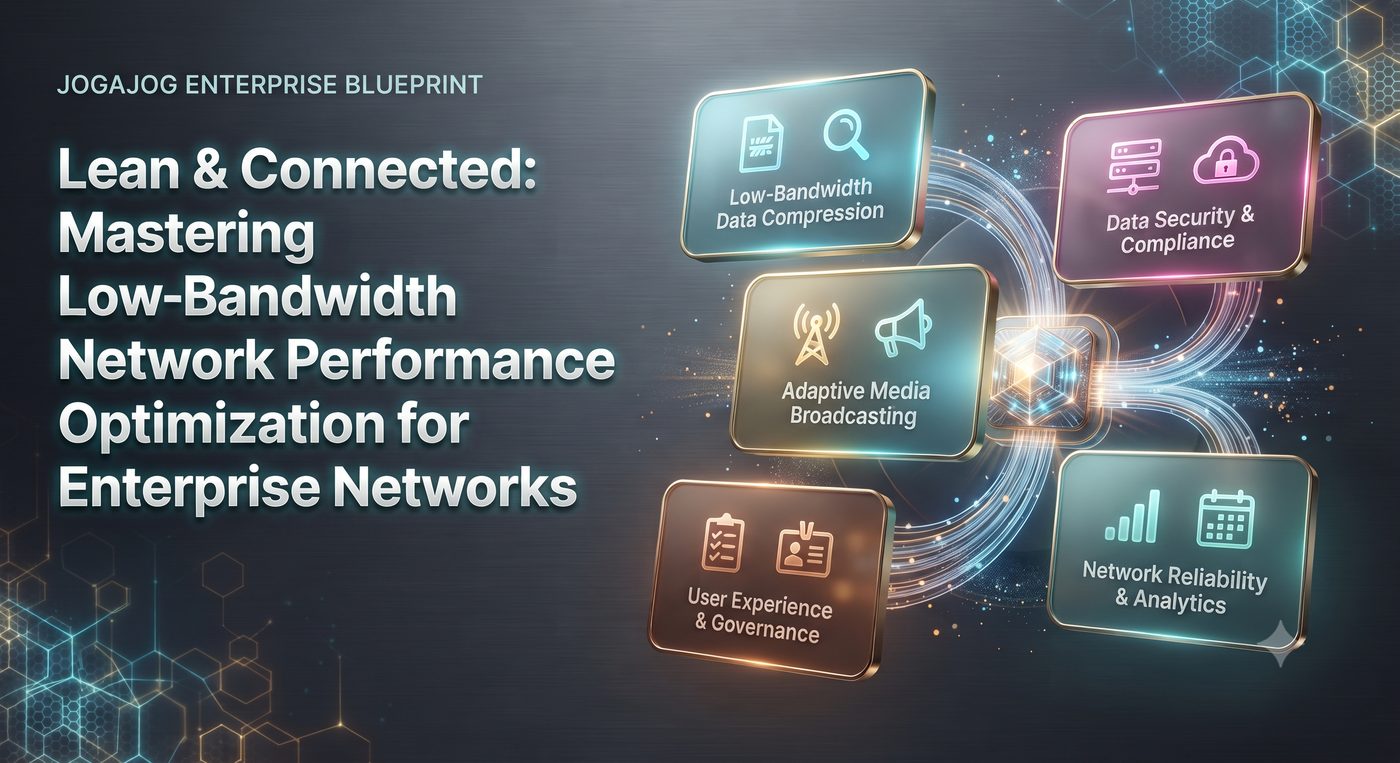
In the modern, globalized enterprise, professional association, or large-scale institution, seamless communication is not a luxury; it is an operational necessity. However, ensuring that every employee, member, or field operative is connected to the centralized directory and communication ecosystem creates a significant technical challenge. High-speed office Wi-Fi is not ubiquitous. Personnel in remote locations, on field sites, or in transit frequently rely on congested public networks, spotty 4G/5G signals, or even legacy satellite connections. Forcing these users to access data-heavy platforms results in catastrophic latency, failed synchronization, and total communication breakdowns.
The Challenge
How can enterprise IT directors, network architects, and operations managers deploy a comprehensive directory application—including real-time search, rich profiles, and broadcasting—that remains responsive, functional, and reliable even when users are operating in severely constrained, low-bandwidth network environments?
The Problem with Bloated or Inefficient Directories
Relying on standard, bandwidth-intensive directory applications introduces severe operational friction and critical communication failures:
* The Latency Deadlock: Heavy web applications that require constant server communication time out instantly on low-bandwidth connections. Users are unable to search, view, or contact critical personnel during emergencies.
* Unreliable Data Synchronization: Large directory databases or full-user-list downloads choke weak connections, leading to incomplete updates, sync errors, and critical contact information being unavailable in the field.
* Catastrophic User Experience: Poor performance destroys user adoption. If the directory app is slow or unresponsive, field staff revert to unmanaged, insecure personal contact lists, bypassing corporate governance and creating security risks.
The Solution: Intelligent Low-Bandwidth Network Optimization
Transitioning to an advanced enterprise communication platform—like Jogajog—solves these challenges by engineering resiliency directly into the application architecture. By mastering intelligent low-bandwidth network optimization, organizations ensure:
* Aggressive Local Caching and Offline Resilience: The application intelligently caches the entire searchable directory structure and user profiles locally on the device. Users can search, browse, and access contact data instantly, even with zero connectivity. Synchronization occurs efficiently in the background when a stable connection is found.
* Optimized Data Payloads: The platform minimizes data transfer by using highly compressed, differential synchronization. Instead of re-downloading entire datasets, only changes (deltas) are transmitted, ensuring updates are fast and bandwidth-neutral.
* Adaptive Media Quality and Streaming: For organizations utilizing broadcast features, the platform automatically detects connection quality and dynamically adjusts media delivery (e.g., reducing image quality, throttling video streams, or defaulting to text-only modes) to maintain service availability over the weakest links.
Frequently Asked Questions
Q: Can users truly search a large enterprise directory when completely offline?
A: Yes. Advanced optimization strategies involve storing a fully indexed, encrypted version of the directory locally on the user’s device. This allows for instantaneous search and retrieval of contact data regardless of current network conditions.
Q: Does low-bandwidth optimization compromise data security?
A: No. Data is securely stored and encrypted on the device. The optimization techniques ensure that only authorized access is permitted and that any locally cached data remains protected within the secure application container, compliant with enterprise governance policies.
See this feature with your own data.
Free branded demo, built from your spreadsheet, this week.
Get your free demo